eISSN: 3134-1470
Editor-in-Chief:
Seyed Naser Emadi, MD.
Deputy Editor:
Zeinab Aryanian, MD.

This journal is a member of, and subscribes to the principles of, the Committee on Publication Ethics (COPE).


Vol 1 No 1-2 (2026)
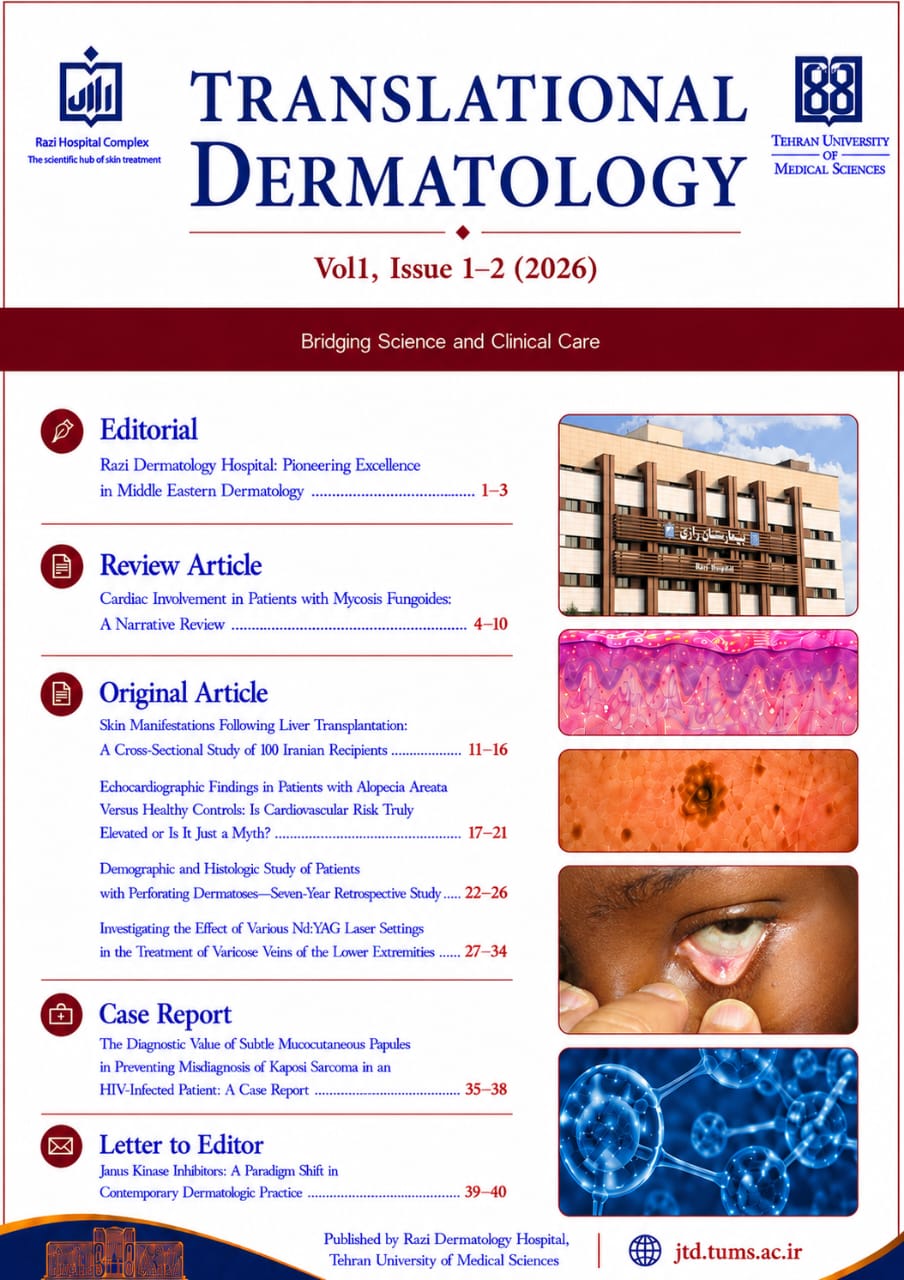
As this inaugural issue goes to press, it is both timely and appropriate to reflect upon the institutional legacy that underwrites this scholarly endeavor. Since its establishment in 1943 under the leadership of Professor Mohammad Ali Maleki, Razi Dermatology Hospital has undergone a remarkable transformation—evolving from a pioneering clinical facility into the largest specialized dermatology center in Iran and one of the most comprehensive skin disease treatment institutions in the Middle Eastern region. Affiliated with Tehran University of Medical Sciences (TUMS), the hospital occupies a unique position at the intersection of clinical care, academic medicine, and research innovation. (To be continued in PDF file)
Background: Primary cutaneous lymphoma (PCL), specifically mycosis fungoides (MF), is a rare type of non-Hodgkin lymphoma primarily affecting the skin. While MF mostly manifests as skin lesions, it can progress to involve any organ, including the heart. Cardiac involvement in MF is a rare complication associated with poor prognosis, emphasizing the importance of early recognition and intervention. This review aims to explore cardiac involvement in MF and its implications for patient prognosis, providing valuable insights for clinical practice.
Methods: A comprehensive literature search was conducted using PubMed and relevant keywords and Mesh terms. Case reports and editorials evaluating cardiac involvement in patients with MF were included in the study. Furthermore, a thorough examination of the references cited in each study was carried out to identify relevant reports. The cases included in the review were analyzed, and common cardiac manifestations and diagnostic approaches were identified.
Results: This review study found multiple instances of cardiac involvement in patients with MF, characterized by symptoms such as heart failure and arrhythmias. Detecting cardiac involvement in MF necessitates a comprehensive approach that combines different imaging methods like echocardiography, cardiac MRI, and CT scans, along with histopathological analysis.
Conclusion: Cardiac involvement in MF is a rare but serious complication that can manifest with various symptoms and cardiac abnormalities. Routine non-invasive imaging techniques play a crucial role in early detection, even in asymptomatic patients. Timely intervention through personalized management approaches, including surgery, when necessary, can contribute to positive cardiovascular outcomes. This review provides valuable insights for clinical practice in managing cardiac complications in MF.
The increased survival of transplant patients, as a result of several advancements in this field, has led to new challenges, including cutaneous diseases, which have an impact on both the quality and quantity of life. This longer-living transplant population has begun to develop dermatological complications, some of which including cutaneous malignancies result in an increase in mortality, and others in a decline in quality of life. This study includes 100 recipients who attended the Imam Khomeini Hospital’s liver transplant clinic for their routine follow-up and were referred to the skin clinic for a dermatologic examination in order to determine the occurrence of skin manifestations Post liver transplantation. At the time of the visit, 85 of the 100 patients had at least one skin problem, including 85 dermatologic diseases with xerosis as the most common, 41 benign skin lesions (the most common of which was melanocytic nevus), 20 infectious disorders (with 6 warts), 5 malignant lesions (with Four basal cell carcinomas and One squamous cell carcinoma), 4 mucosal candidiasis, 1 aphthous lesion, and various nail manifestations. This study demonstrates that liver transplantation requires lower immunosuppression than other solid organ transplants, but skin manifestations are more frequent than in the general population; therefore, skin care must be part of the clinical approach for these patients.
Due to its inflammatory characteristics, AA may be regarded as a potential risk factor for cardiocerebrovascular events. To address this issue, we conducted a single-center prospective crosssectional study on 26 adult patients who were clinically diagnosed with AA and 26 age- and sexmatched healthy controls from March 2022 through February 2023. After obtaining informed written consent from all participants, they were referred to the cardiology department for ECG recording and trans-thoracic echocardiography by a qualified echocardiologist using the Philips Healthcare Affinity 70c system with an S1–5 transducer. The study comprised 22 males (11 patients and 11 controls) and 30 females (15 patients and 15 controls). The mean age of the patient group was 41.21 ± 9.14 years, whereas the control group had a mean age of 39.28 ± 8.35 years. We did not find any significant alteration in echocardiographic and electrocardiographic features of patients with AA compared to healthy controls. In conclusion, our results did not indicate the need for prompt cardiac monitoring in AA patients.
Background and Aim: Perforating dermatoses are uncommon skin disorders that are characterized by the extrusion of dermal elements through the epidermis. To evaluate the demographic, clinical, and histological features of patients with perforating dermatoses.
Materials and Methods: This is a seven-year retrospective study, from 2013 to 2019, at Razi Dermatology Hospital, including 100 patients with confirmed perforating dermatoses, aged between 15 and 85 years. Demographics, clinical presentation, associated comorbidities, and histopathological findings were recorded and analyzed using SPSS version 22. The significance level was considered p < 0.05.
Results: Our population consisted of 52% (52) females and 48% (48) males, with a mean age of 49.7 years. Diabetes (55%) and CKD (25%) were the most common comorbidities. Perforating folliculitis was diagnosed in 71 patients, while 29 had reactive perforating collagenosis. Histopathological analysis revealed key findings: perforating folliculitis cases displayed dilation of the follicular infundibulum, compact parakeratotic plugs, basophilic debris from inflammatory cells, and collagen bundles perforating the follicular epithelium, accompanied by perifollicular inflammatory infiltration. The characteristic findings in the cases of reactive perforating collagenosis included keratotic plugs within epidermal channels, degenerated collagen bundles in the widened papillary dermis, and neutrophilic scale crusts. Lesions predominantly involved the lower extremities (51%), followed by the trunk (14%), and scalp (8%). These Histopathological patterns were consistent across cases, affirming the diagnostic markers of each condition.
Conclusion: This study emphasizes that perforating dermatoses are strongly associated with systemic conditions such as diabetes (55%) and CKD (25%), thus demanding comprehensive management approaches. The histopathological consistency of the perforating dermatoses not only confirms diagnostic reliability and demographic variations but also suggests the need for further research on potential regional influences. These insights provide a foundation for improving therapeutic strategies and enhancing outcomes for patients with these challenging dermatologic conditions.
Background: Varicose veins are among the common skin problems. This study aimed to evaluate different settings for the treatment of varicose veins of the lower limb with Nd:YAG laser.
Methods: The current study was a double-blind clinical trial. Thirty-seven patients with varicose veins <3 mm in size underwent 2 sessions of Nd:YAG laser treatment with a two-month interval. Follow-up of the patients was done at 2 and 4 months after the first laser session.
Results: A significant change in response to treatment was observed after the second laser session compared to the first laser session (p < 0.001). After the first laser session, the recovery rate was above 50% for only 4 patients (11.1%), but after the second laser session, 18 participants experienced above 50% clinical improvement. The response rate in the group of patients who had no family history was higher than in other patients. A significant relationship was observed between the response to treatment after the second session of laser and the size of the lesion (p < 0.002). Moreover, a significant relationship was seen between the response rate to treatment with lasers of different fluences both after the first session and after the second laser session (p < 0.05).
Conclusion: Although sclerotherapy is still the gold standard for the treatment of vascular lesions of the lower limbs, the most modern treatment method is the use of Nd:YAG laser, especially in patients with lighter and thinner skin and patients with injection phobia.
Kaposi’s sarcoma (KS) is a rare multifocal angiogenic tumor often seen in an immunocompromised setting such as acquired immunodeficiency syndrome (AIDS) or in organ transplantation recipients. Here, we describe an 18-year-old HIV-infected female patient who developed pulmonary and lymph node disease with features mimicking tuberculosis. This case of KS suggests that dermatologists visiting HIV-infected patients with respiratory symptoms should have a high degree of awareness and consider other differential diagnoses along with merely an opportunistic infection such as tuberculosis.
Over the past decade, the introduction of Janus kinase (JAK) inhibitors has profoundly reshaped the therapeutic landscape of dermatology. By selectively targeting intracellular signaling pathways central to immune dysregulation, these small-molecule agents have offered a level of efficacy, rapidity of response, and disease control that was previously unattainable for many chronic inflammatory and immune-mediated skin disorders. Collectively, emerging clinical trial data and real-world experience support the view that JAK inhibitors represent a genuine paradigm shift in contemporary dermatologic practice.
eISSN: 3134-1470
Editor-in-Chief:
Seyed Naser Emadi, MD.
Deputy Editor:
Zeinab Aryanian, MD.
This journal is a member of, and subscribes to the principles of, the Committee on Publication Ethics (COPE).
 |
All the work in this journal are licensed under a Creative Commons Attribution-NonCommercial 4.0 International License. |